
-1920w.webp)



.svg.png)



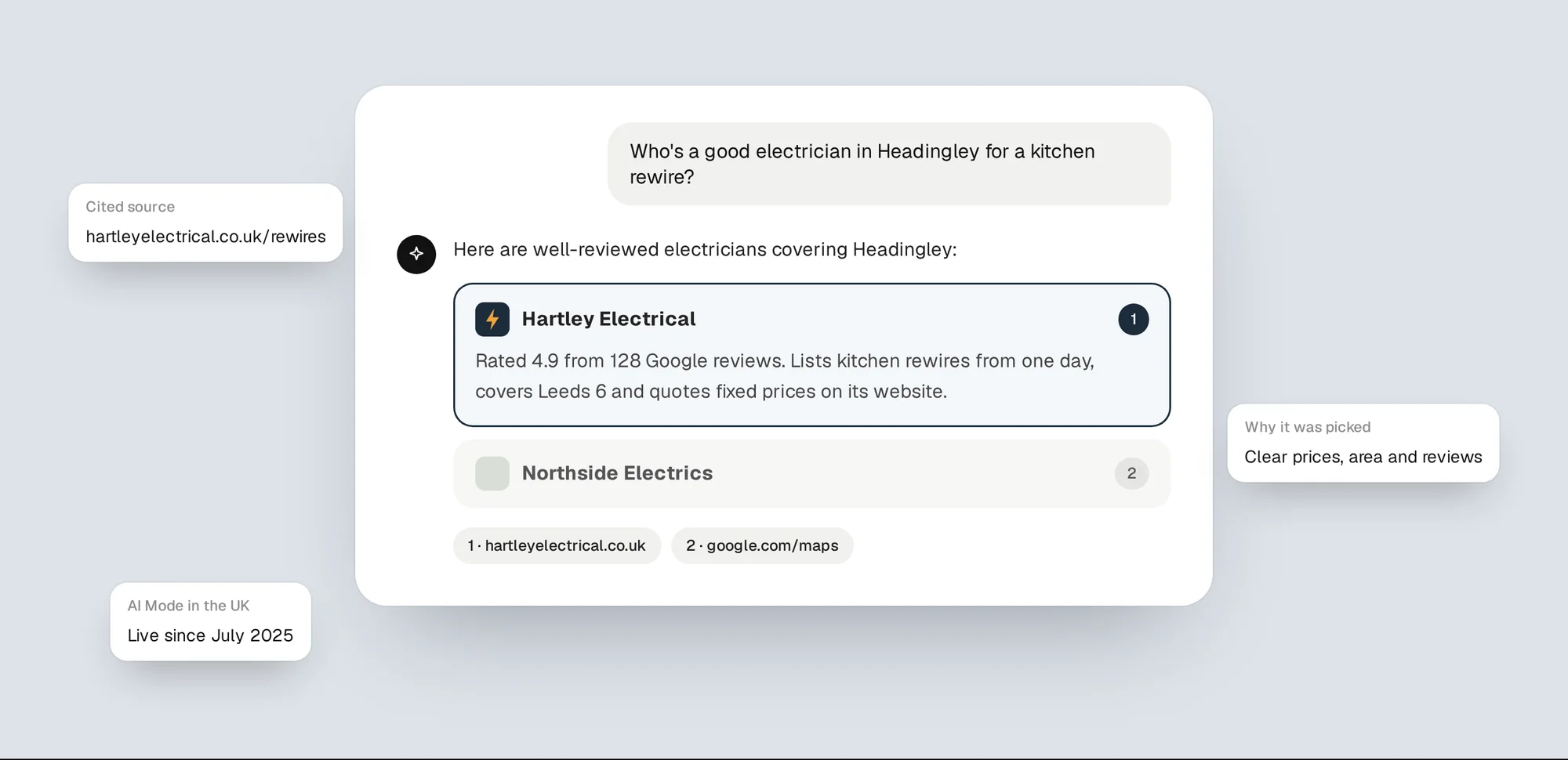
Ask ChatGPT for a good electrician in your town and it won't give you ten links. It gives you an answer, names two or three businesses, and maybe shows where it got that from. If your business isn't in that answer, the customer may never see you. GEO is the work of getting into it.
Where the term came from
GEO comes from a research paper. In November 2023, a team from Princeton, Georgia Tech, the Allen Institute for AI and IIT Delhi published "GEO: Generative Engine Optimization", later presented at the KDD conference in 2024. They tested what makes AI search engines more likely to use and cite a web page in their answers.
Their headline finding was that the right changes to a page could boost its visibility in AI answers by up to 40%. That number got quoted everywhere. The detail behind it is more useful.
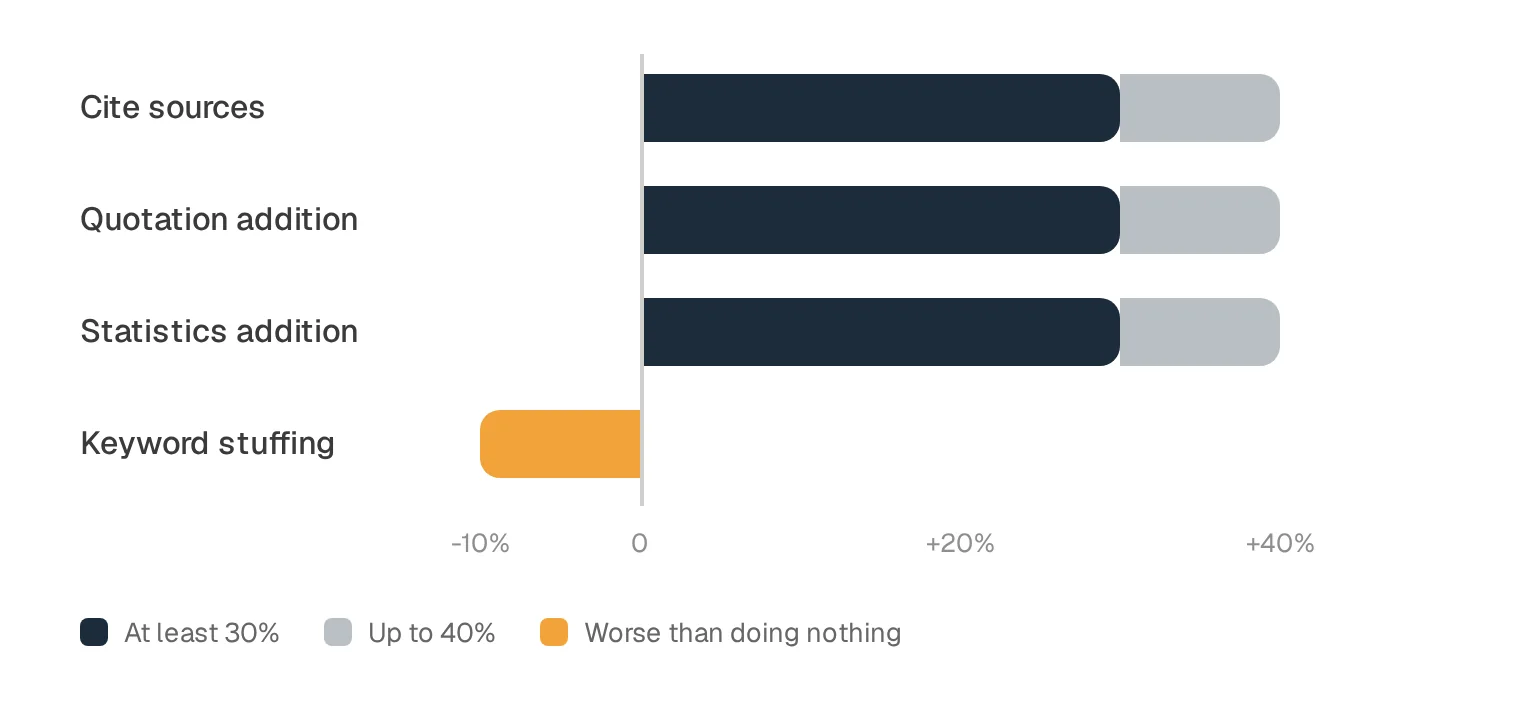 What moved the needle in the GEO study. The best methods improved visibility by 30 to 40%. Keyword stuffing made it worse.
What helped most: citing sources, adding quotations from credible people, and adding statistics. In other words, being specific and checkable.
What didn't: keyword stuffing. Repeating the search phrase over and over did around 10% worse than doing nothing in their Perplexity test.
Who gained most: pages that weren't already at the top. In one test, citing sources lifted the fifth-ranked source by 115%, while the top-ranked source actually lost ground. For a small business up against bigger names, that's encouraging.
Why it matters now
AI answers aren't a side feature any more. Google launched AI Overviews in the UK in August 2024 and AI Mode, its full AI search experience, in July 2025. By its 2026 developer conference, Google said AI Mode had passed a billion monthly users. ChatGPT reported 900 million weekly users in February 2026.
And people click less when an AI answer appears. Pew Research tracked real browsing in the US and found that people clicked a normal search result on 8% of visits when an AI summary appeared, against 15% when it didn't. They clicked a link inside the summary itself on just 1% of visits.
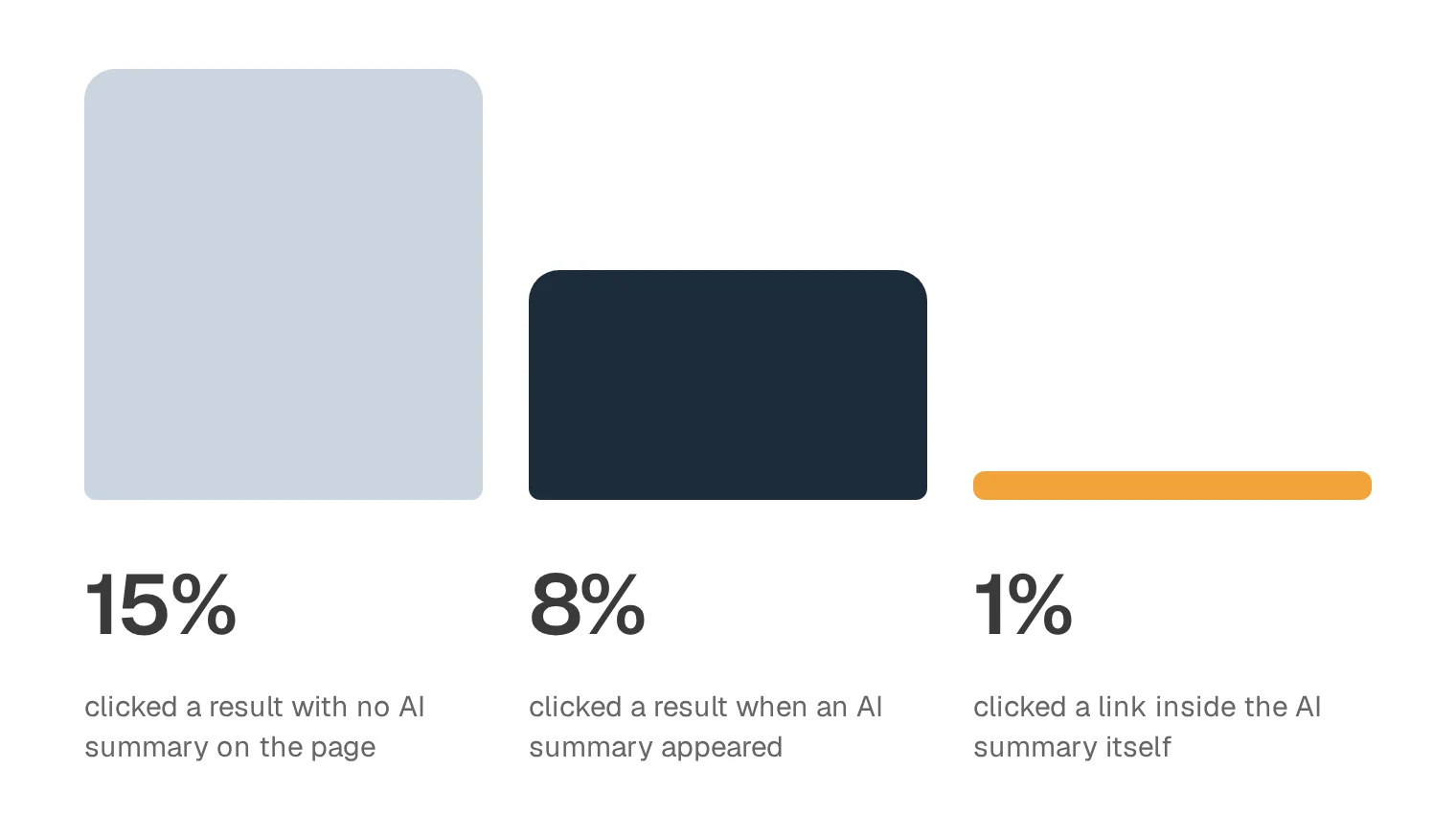 When an AI summary shows, fewer people click through. Pew Research Center, US browsing data, March 2025.
For local businesses, the shift is already visible. BrightLocal's 2026 survey of US consumers found 45% now use ChatGPT or other AI tools for local recommendations. UK figures are thinner, but the direction is the same.
How GEO differs from SEO
GEO isn't a replacement for SEO. AI tools still lean heavily on search indexes to find pages, so the basics of SEO, like a fast site, clear page titles and being listed on Google, still count. What changes is the goal.
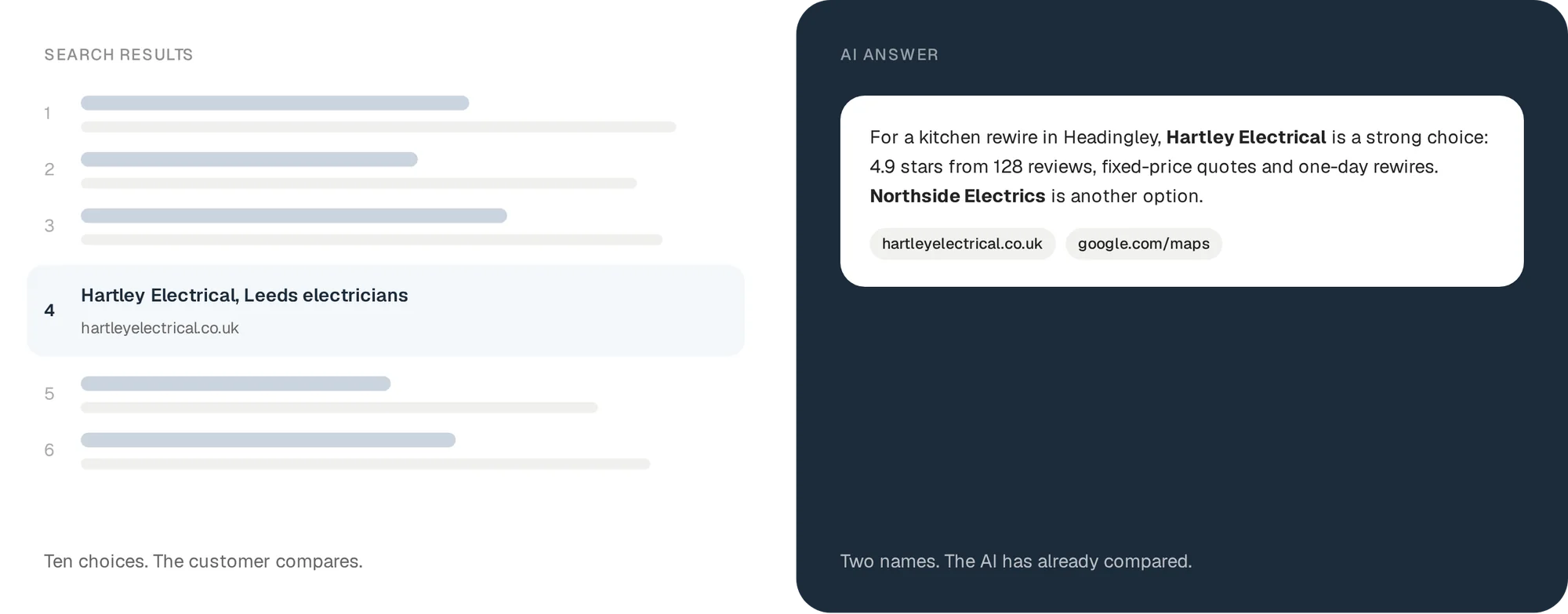 Search gives a list. An AI answer gives a shortlist, and you're either on it or you're not.
| SEO | GEO | |
|---|---|---|
| The goal | Rank high in a list of links | Be named or cited in the answer |
| What wins | Relevance, links, a good page | Clear facts AI can quote and trust |
| Where it shows | Google's blue links and map pack | ChatGPT, AI Overviews, AI Mode, Perplexity |
| How you measure it | Rankings and clicks | Mentions, citations and enquiries |
What a small business can do this week
You don't need a GEO agency to start. Most of what the research rewards is what a good website should do anyway: say clearly what you do, where, and why people trust you.
- State the facts plainly. Your trade, the towns you cover, your opening hours, your accreditations. Put them in text on the page, not just in images.
- Answer the questions customers ask. "How much does a consumer unit replacement cost?" "Do you do emergency callouts in Leeds?" Write a short, direct answer on your site.
- Add numbers you can stand behind. Years trading, jobs completed, response times. Specific beats vague. Never make them up.
- Show your sources. If you mention a regulation, like Part P, link to the official page. It's one of the methods that worked best in the study.
- Quote real people. A line from a customer review, with their first name and town, is a quotation AI can use.
- Keep your details consistent. The same name, address and phone number on your website, Google Business Profile and directories helps AI tools be confident it's you.
- Don't stuff keywords. It didn't work in the research and it reads badly to people too.
A quick test: ask ChatGPT and Google's AI Mode "Who's a good [your trade] in [your town]?" Note who gets named and which pages are cited. Run it again in a month. That's your baseline.
Our five-minute audit walks through this test in more detail, and How to rank in AI answer engines goes deeper on structure and schema.
What GEO won't do
GEO won't fix a business that customers don't rate. AI tools read reviews and they read what other sites say about you. If those are thin or poor, no amount of rewriting your homepage will put you at the top. The best GEO for a local trade is still good work, plenty of honest reviews and a website that says clearly what you do.
Questions people ask
Is GEO the same as AEO or AI SEO?
Broadly, yes. AEO (answer engine optimisation) and AI SEO describe the same goal: being found and cited by AI tools. GEO is the term from the original research paper.
Can I pay to appear in ChatGPT's answers?
Not in the organic answers. They're based on what the model and its search tools find. Be wary of anyone selling guaranteed AI placements.
Does GEO replace SEO?
No. AI tools rely on search indexes to find pages, so a site that ranks well on Google has a head start. Think of GEO as SEO with a different finish line.
How do I know if it's working?
Ask the AI tools directly every month, track where enquiries say they found you, and watch your website analytics for visits from AI tools.